The somatotropic axis is pulsatile, and that single fact structures most of the research around it. A system that operates in bursts cannot be characterised by a single measurement, and compounds acting on it are described in terms of pulse amplitude and frequency rather than a steady level.
The first door: GHRH receptor
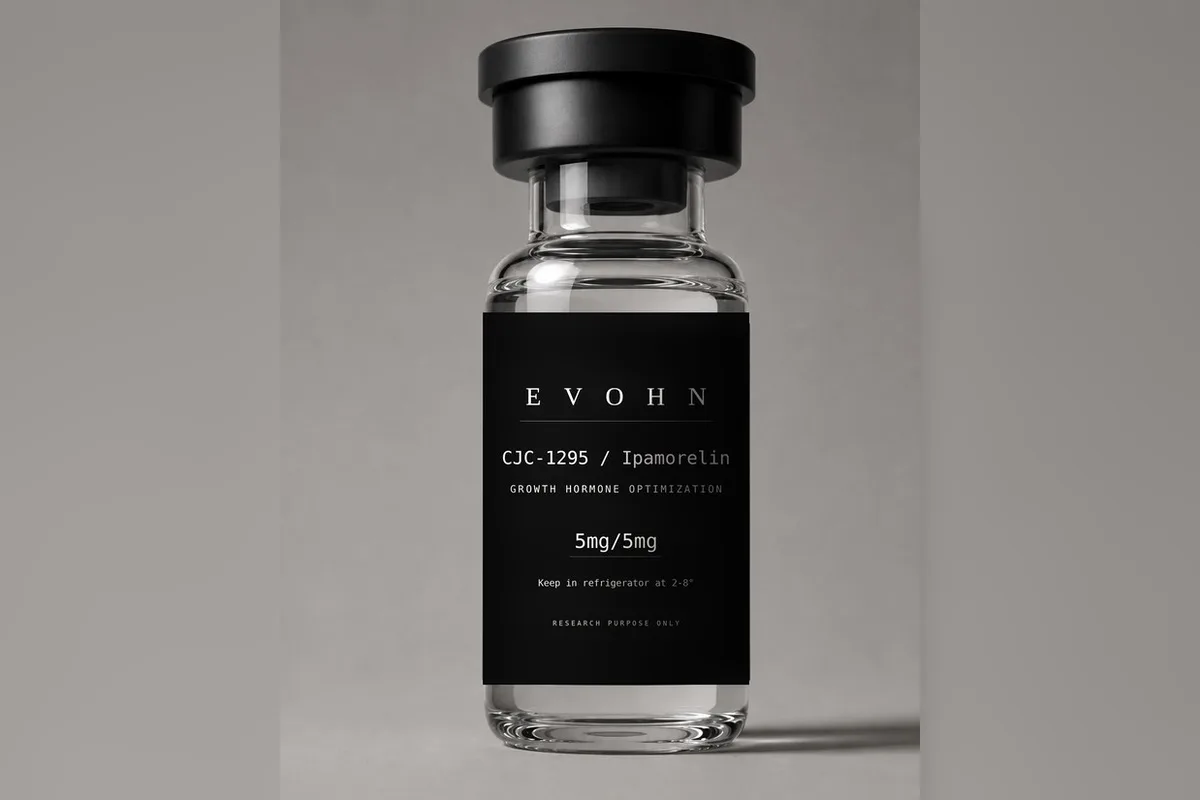
CJC-1295 is a synthetic analogue of growth hormone-releasing hormone modified at four positions to resist enzymatic cleavage — principally by dipeptidyl peptidase-4, which rapidly inactivates the native hormone. It engages the GHRH receptor on somatotrophs, raising cyclic AMP through Gαs and increasing the amplitude of secretory pulses.
The second door: GHS-R1a
Ipamorelin is a selective pentapeptide agonist at the growth hormone secretagogue receptor, acting through a Gq-coupled route and therefore a different intracellular cascade. Its significance in the literature is as much about what it does not do: earlier secretagogues carried cortisol and prolactin cross-reactivity that confounded interpretation, and Ipamorelin's selectivity was the advance that made clean characterisation possible.
Why sampling schedules dominate the design
In a pulsatile system a single time point can miss the effect entirely — or catch a trough and report it as a null result. Published designs allocate substantially more attention to sampling schedule than is typical for receptor-level work, and results from studies that do not report their schedule are difficult to interpret.
The asymmetry to account for
The two components have markedly different reported clearance — roughly thirty minutes for CJC-1295 without DAC against approximately two hours for Ipamorelin. Treating the pair as a single agent with one time course discards that difference, and with it much of what makes the combination worth studying.