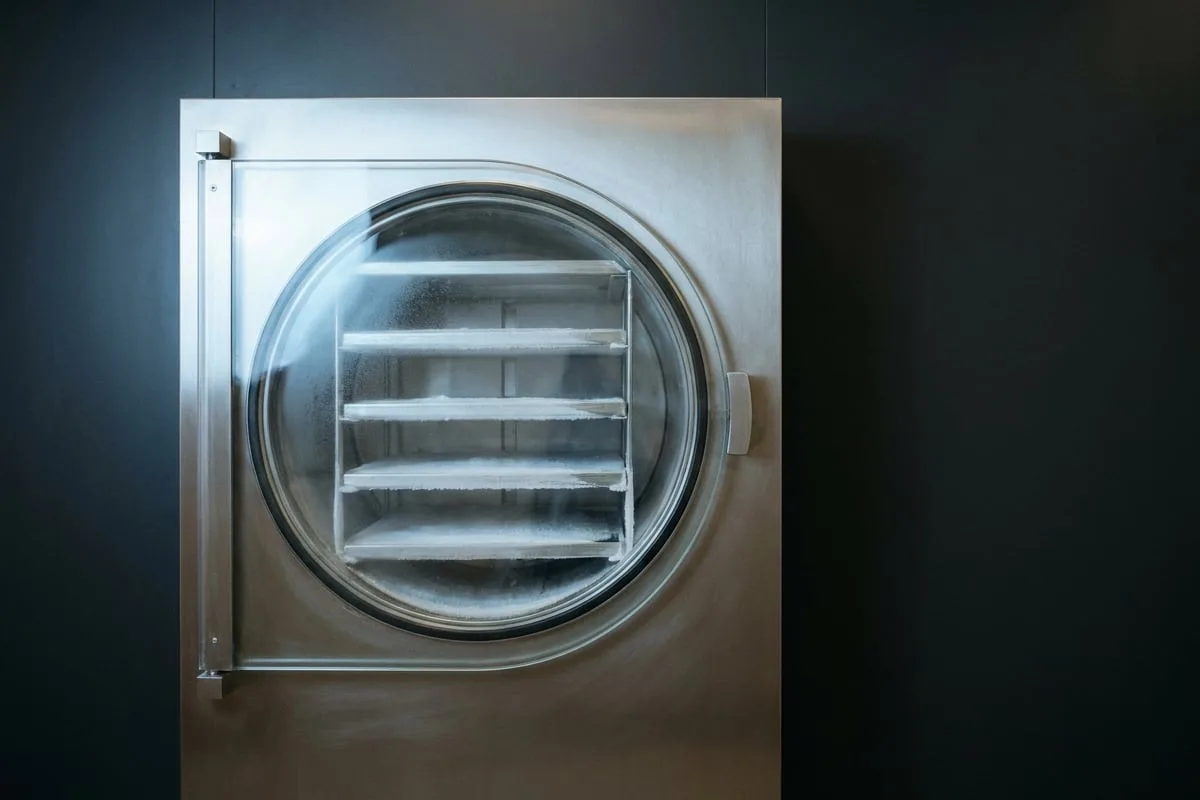
Freeze-drying is not a packaging convenience. Water is the medium in which hydrolysis, deamidation and oxidation proceed, and removing it slows all three by orders of magnitude. A lyophilised cake at −20 °C is a compound in suspended animation. Adding diluent ends that state deliberately, and every handling decision after it is a decision about how fast the clock now runs.
Before the seal is broken
Allow the vial to reach ambient temperature first. A vial opened cold draws in atmospheric moisture, which condenses onto a cake specifically engineered to have none. The material has begun degrading before any diluent is introduced, and the damage is invisible.
Introducing diluent
- Direct the stream against the vial wall, not onto the cake. A jet of liquid onto lyophilised material generates local shear and foaming.
- Swirl gently; do not shake. Agitation at an air-liquid interface denatures peptides — the foam is the visible symptom of that.
- Allow time. A cake that appears not to dissolve often simply has not been given the two or three minutes it needs.
- Record the diluent and the volume. Concentration is meaningless without both.
Why bacteriostatic water is the usual choice
Bacteriostatic water contains 0.9% benzyl alcohol, which inhibits microbial growth and therefore permits a preparation to be drawn on more than once. Sterile water contains no preservative and is intended for single use. The choice is between a preparation that survives multiple withdrawals and one that does not, and it should be recorded because it affects how long the solution remains valid.
When a solution looks wrong
Cloudiness, visible particulate, or a solution noticeably more viscous than expected are all worth investigating rather than dismissing. Some peptides gel at concentration because of intermolecular association — a physical phenomenon, not necessarily degradation. Others cloud because they have exceeded solubility at the working pH. The distinction matters, and it is usually resolved by checking the concentration against the compound's documented solubility before assuming the material is at fault.
The interval on the certificate
Reconstituted stability is compound-specific and is stated on the batch certificate. Where several compounds are in solution simultaneously, the shortest interval in the set governs the whole preparation — not the average, and not the longest.