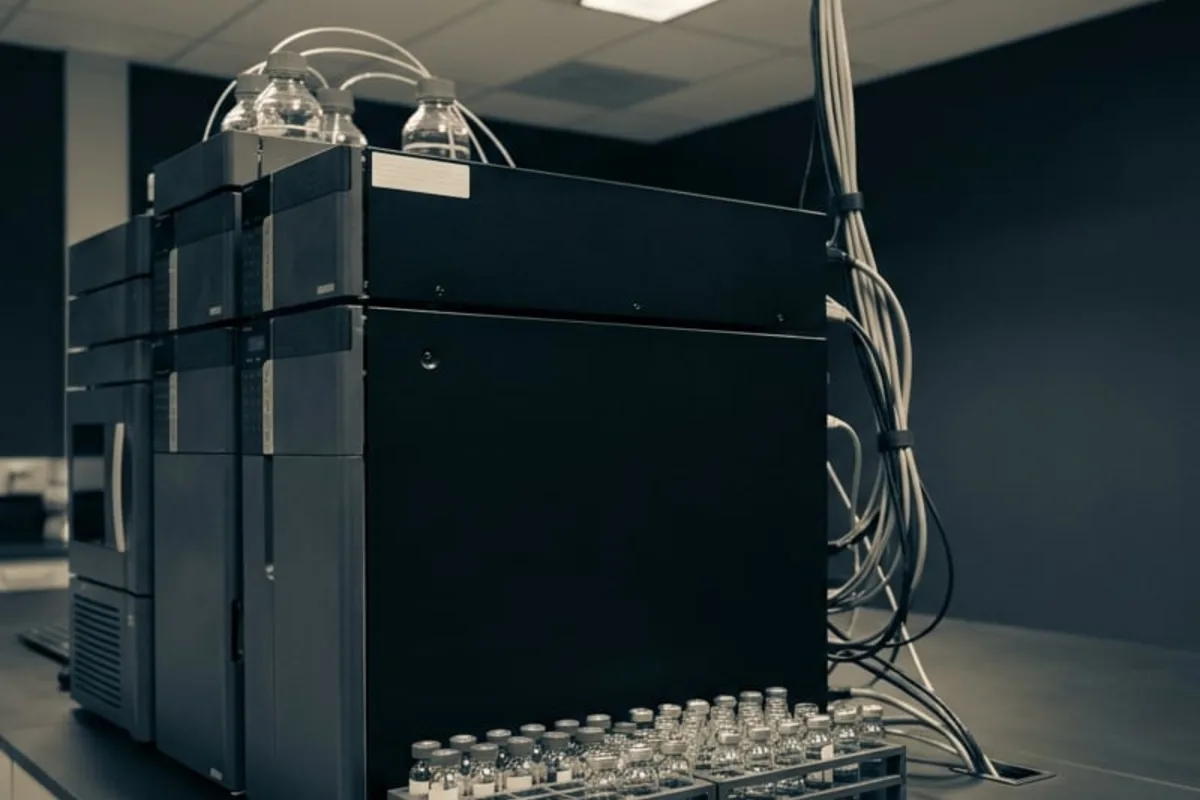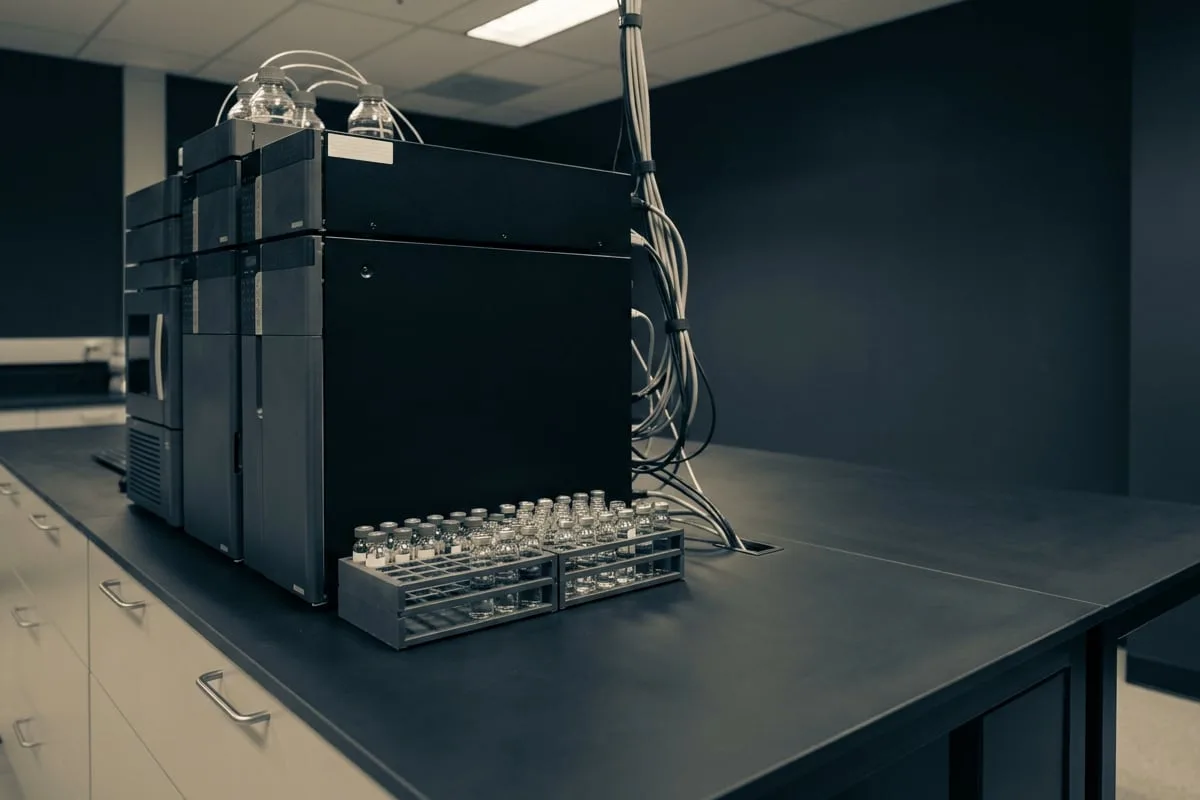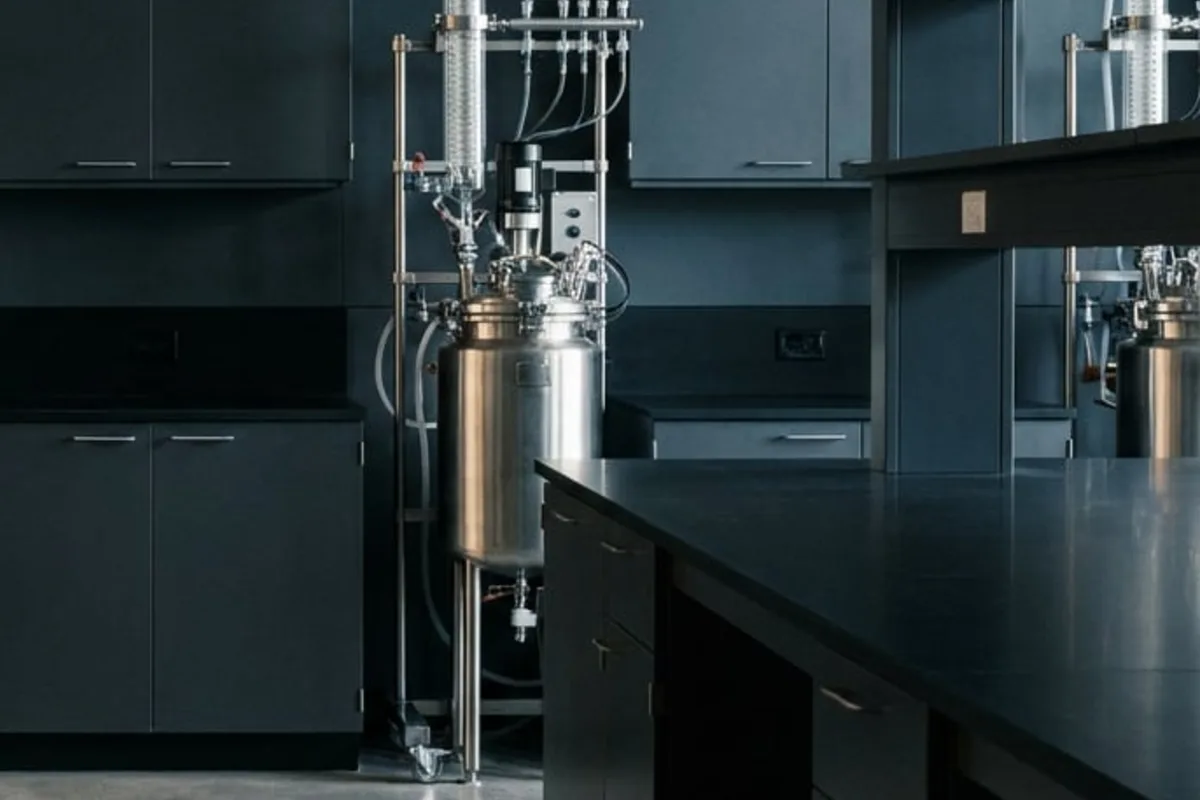
A certificate of analysis is the output of several instruments, each answering a narrow question. Read as a set, they describe a batch. Read individually, each is easy to over-interpret. What follows is what each technique measures, and — more usefully — what it cannot.
High-performance liquid chromatography
HPLC separates a mixture by pushing it through a packed column under pressure. Components partition between the mobile and stationary phases according to their physicochemical properties and emerge at characteristic times. In reversed-phase mode — the standard for peptides — separation is driven by hydrophobicity. The output is a chromatogram, and purity is calculated from relative peak area.
- Answers: how homogeneous is this sample?
- Cannot answer: what is the principal component?
- Common pitfall: co-elution, where two components emerge together and read as one peak.
Mass spectrometry
The sample is ionised and the resulting ions separated by mass-to-charge ratio. For peptides, electrospray ionisation produces a series of multiply charged species from which the molecular weight is deconvoluted. A measured mass within a few daltons of the theoretical value is strong evidence of identity; a systematic offset is strong evidence of a specific structural difference.
- Answers: what is the molecular weight, and does it match the named compound?
- Cannot answer: how much of the sample is that compound.
- Common pitfall: reporting a mass without reporting the deviation from theoretical.
Karl Fischer titration
A specific chemical determination of water content, and one of the least glamorous entries on a certificate. It matters because lyophilised material is weighed as a mass, and any water in that mass is not compound. A cake with 8% residual moisture delivers 8% less material than the label implies, before any other variance is considered.
Residual solvent analysis
Synthesis and purification use organic solvents — acetonitrile, trifluoroacetic acid, dimethylformamide among them. Residual solvent analysis, typically by gas chromatography, quantifies what remains. It is a direct read on how carefully the material was worked up, and it is the section most often omitted from thin certificates.
Appearance and solubility
The simplest observations on the document, and the first to catch a gross problem. A cake that has collapsed, discoloured, or fails to go into solution as expected is telling you something no instrument needs to confirm. Where a compound has a characteristic solution colour — the deep blue of a copper complex, for instance — its absence is a result in itself.